
Case
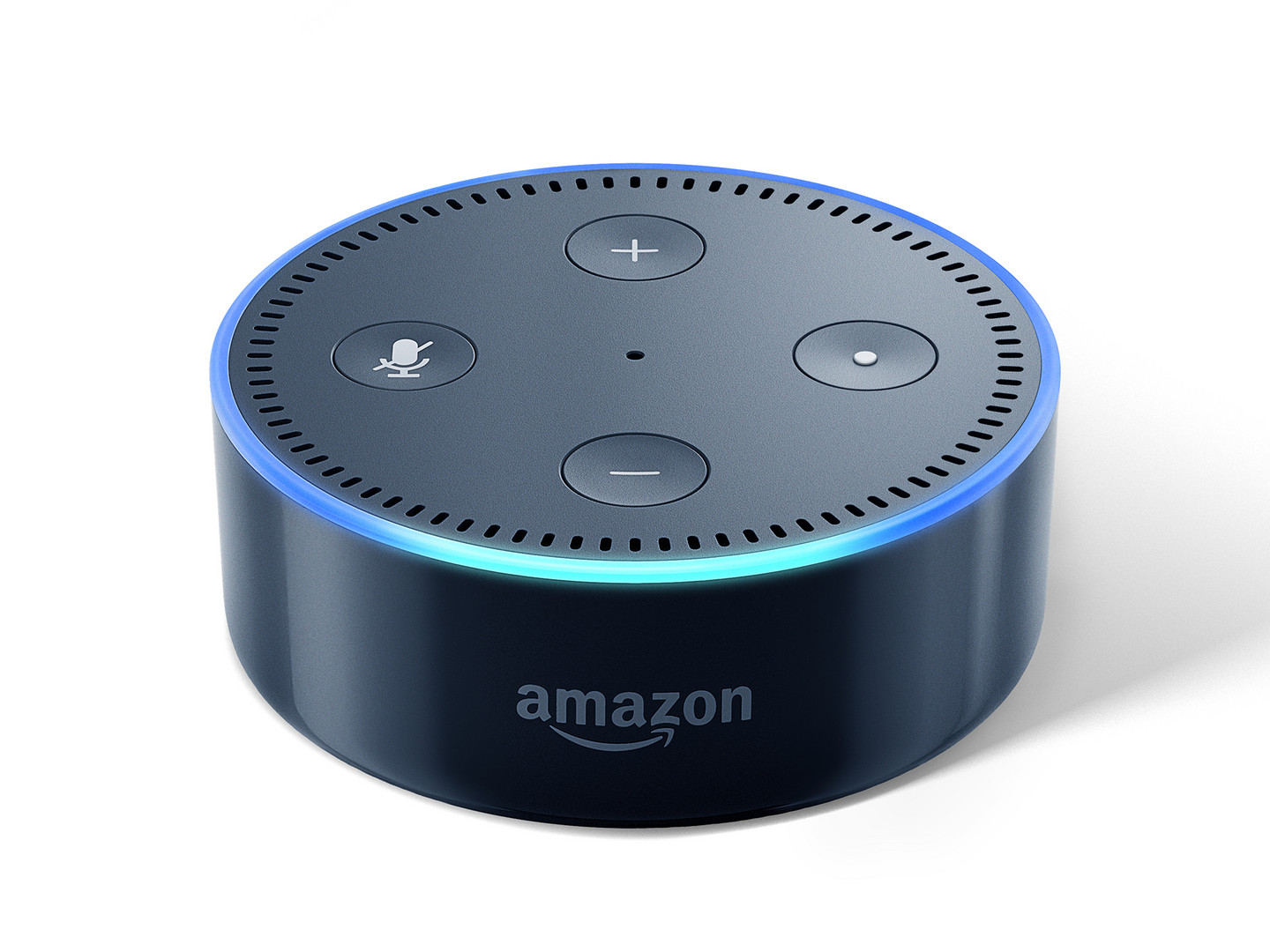
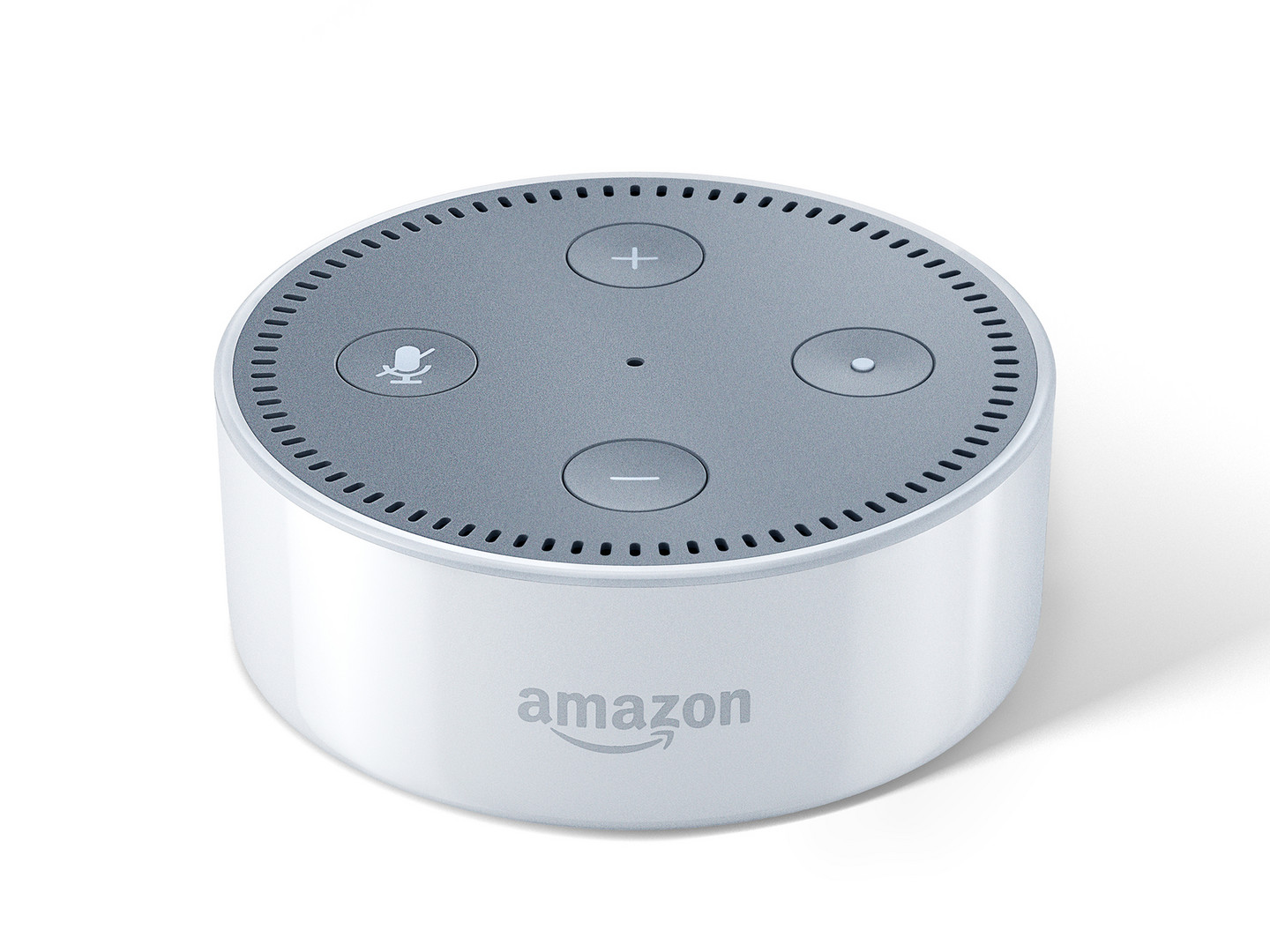
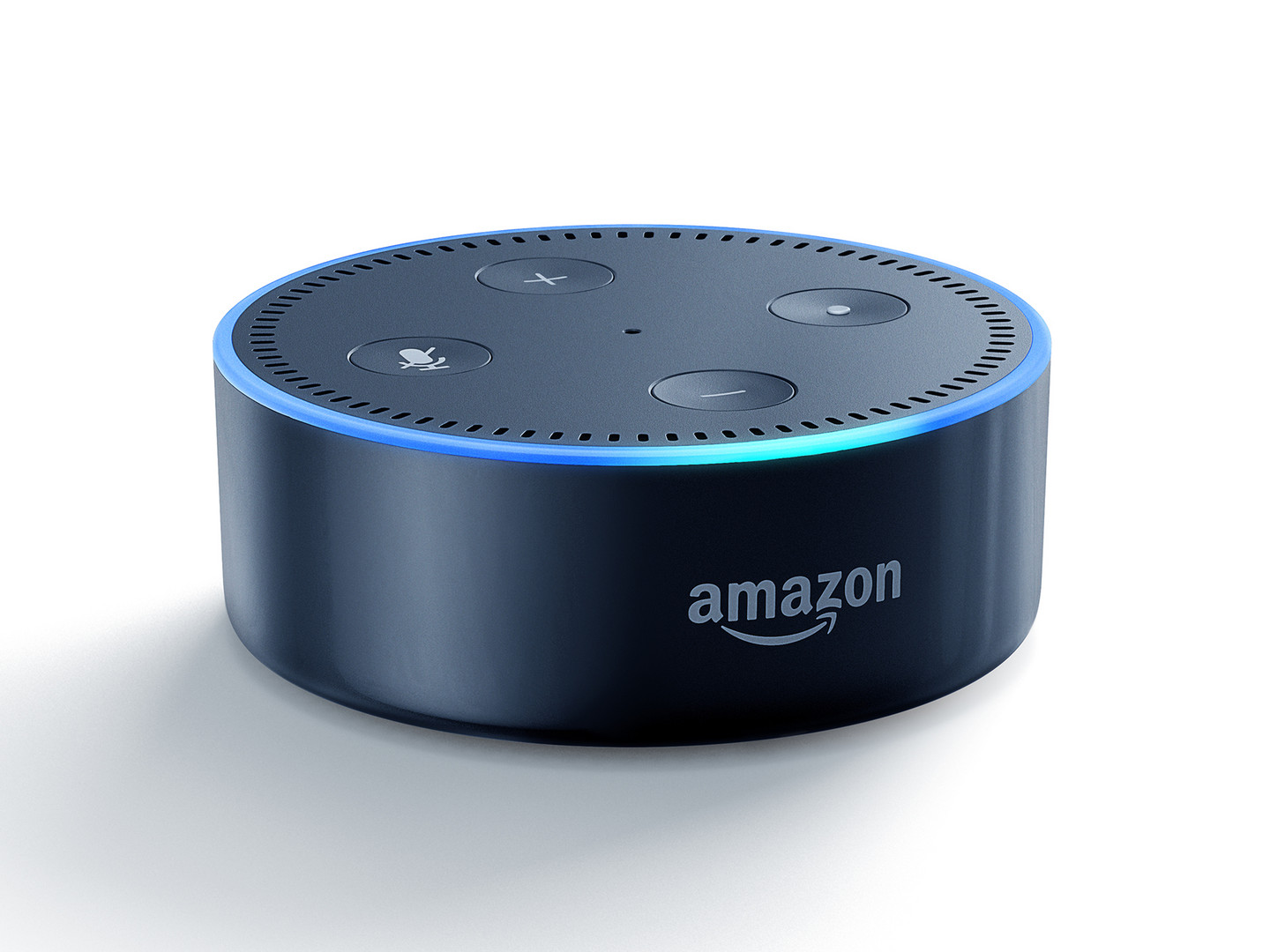
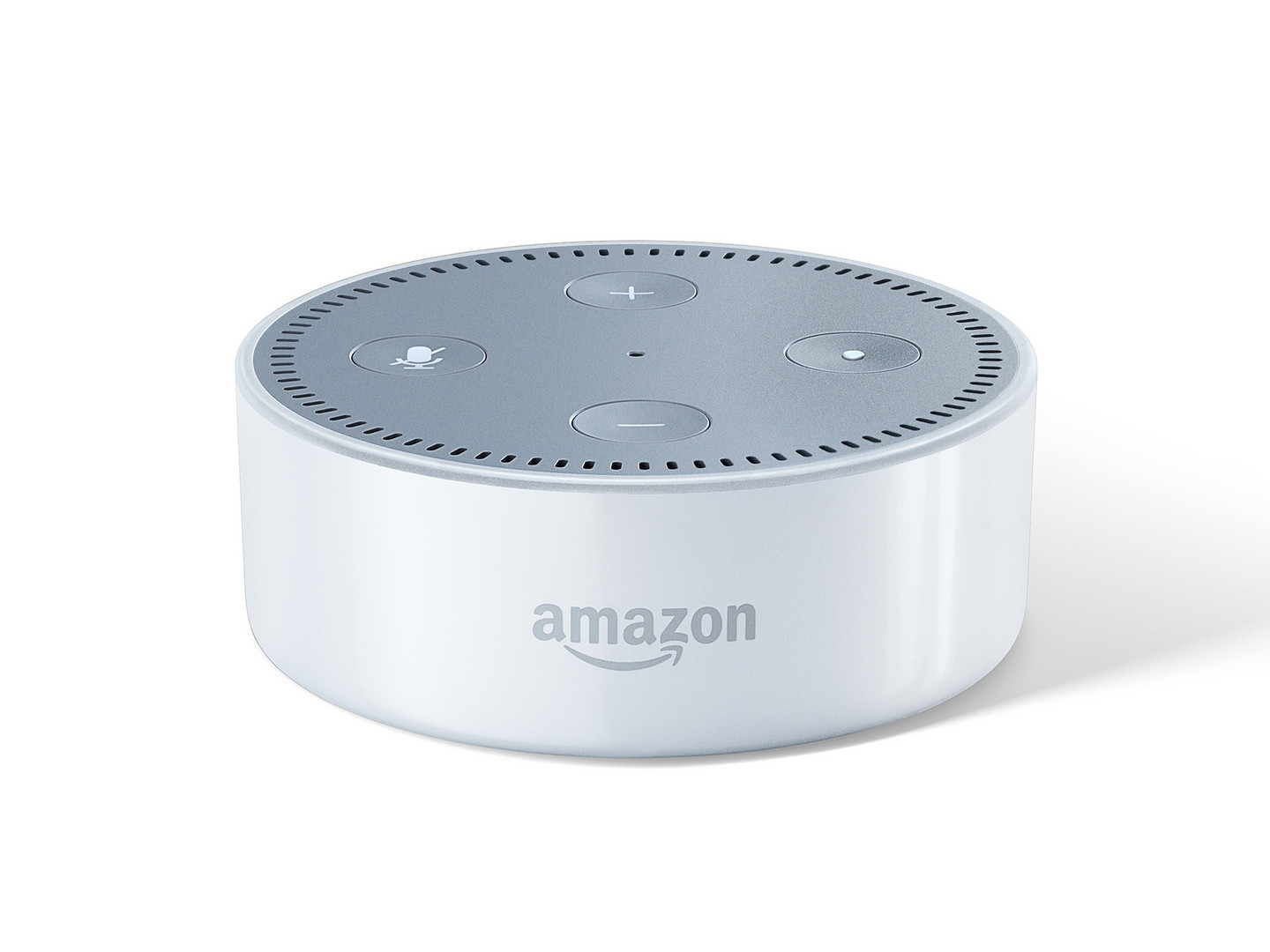
Amazon's Echo Dot has a diameter of 83.5 millimeters (~3.3 in) and weighs 163 grams (~5.7 oz) without its cable. Thus, it is relatively compact and can easily fit on small surfaces. Its rubber-coated underside prevents it from slipping on smooth surfaces.
Glossy plastic dominates the casing's exterior, and it is available in black and white. Fabric or leather cases (~10 Euros/~$15) that give the Echo Dot a higher-quality appearance are also available.
It is a pity that the white model also comes with a black power supply and cable.
Connectivity
Amazon's Echo Dot connects to the home network via Wi-Fi. The Wi-Fi module supports the IEEE 802.11 a/b/g/n standards and can use both the 2.4 and 5.0 GHz networks. The more modern ac standard is not supported, but the capacities of the supported standards are quite sufficient for all tasks and even bigger distances to a router (Fritz!Box 6360, 15 meters/~49 ft, angled hallway) were not a problem in the test. Bluetooth is also present; unfortunately, Amazon does not specify the exact version.
A micro USB port for supplying power and a 3.5-mm audio jack are in the casing's bezel below the plus sign. The latter allows connecting the Echo Dot to external speakers. However, users who believe that they can connect the Dot to the stereo system and can still experience a great sound will be disappointed. The connected receiver is then the only output source and the internal speaker is muted. Rather, the audio jack is made for connecting a headphone to Amazon's Echo Dot when the device is used as a streaming client.
Data security
Probably the most sensitive aspect of using Amazon's Echo products is the data security issue. According to the US Company, the device's seven microphones only record when a trigger word is uttered. The Echo does not analyze the audio file, but it is sent to an Amazon server and processed there. This server does not have to be situated in Germany so that it is possible that the request is processed in a country with weaker data security acts. Furthermore, it makes it easier for secret services and hackers to access data, especially since no information concerning encryption is available. Thus, it is quite possible for third parties to use the microphones for wiretapping the user.
The consumer rights organization of North Rhine-Westphalia has also examined Amazon's Echo products and sees a risk in using the services and in accepting the data privacy statement. Not only Amazon itself uses the gathered information for analyzing consumer's behavior, but it also is allowed to divulge information to third parties within the legal regulations. We would recommend studying articles of consumer organizations for learning how high the data protection risks are for the user and for his/her guests.
Handling
Setting up Amazon's Dot is very easy. The device has only to be connected to an outlet and the free Alexa app (Android and iOS) guides the user through the installation step by step. Additional Echoes can be added or removed via the app later, and it provided information about active Skills, recent voice commands and the organization of Amazon skills and utilized standard applications.
Amazon's assistant Alexa is activated by calling out the preset word (at test time: Alexa, Amazon, echo or computer). The LED ring on the casing that lights up gradually and aligns itself to the user indicates activation visually.
Voice recognition functioned very well, even in a somewhat louder environment, although the user had to speak a bit louder. The provided services worked quite reliably and we only rarely had to repeat a command. Alexa automatically uses Prime Music when music is demanded, but other providers can be selected as the standard service in the app, which also functioned well. In addition, Echo Dot also supports Spotify Connect and thus the device is largely independent of the smartphone. However, it would be practical if the output speaker in Spotify could be switched via a voice command for transmitting the signal to an AV receiver, for example. Knowing the right keywords is important for good voice control so that Alexa understands the corresponding commands.
Many functions can be supplemented via the so-called Skills that add corresponding voice commands from the individual provider to Alexa. These can be an ordering function for delivery services or cabs and even news services or smaller games. Generally, Alexa provides many options out-of-the-box. For example, the user can place orders in Amazon's store or call up the current cinema program, play Audible audio books or keep their personal calendar up-to-date. Among other services, Google and Outlook.com are supported for this purpose. We deem placing orders at Amazon via Alexa as a bit risky, especially when children live at home.
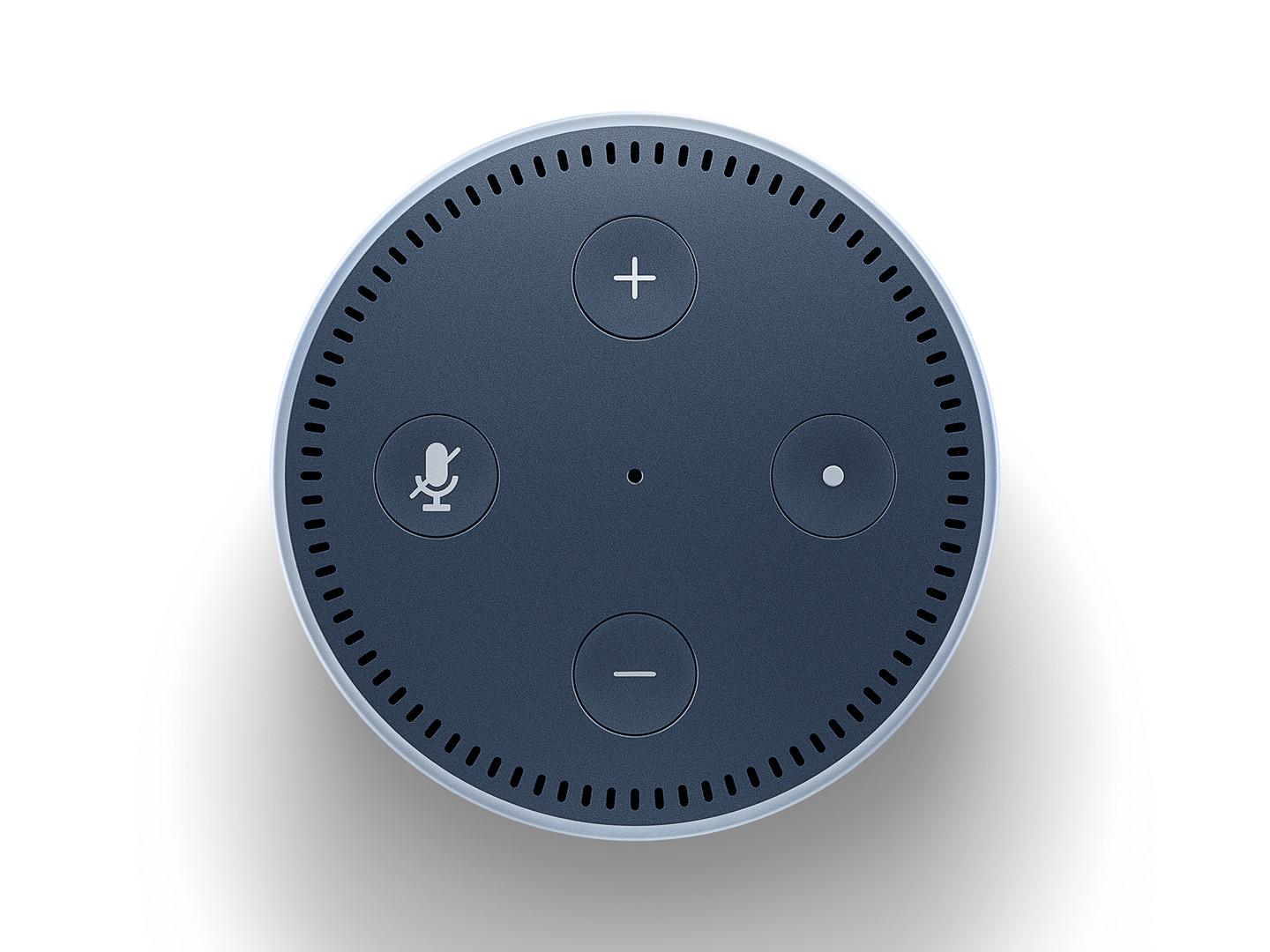
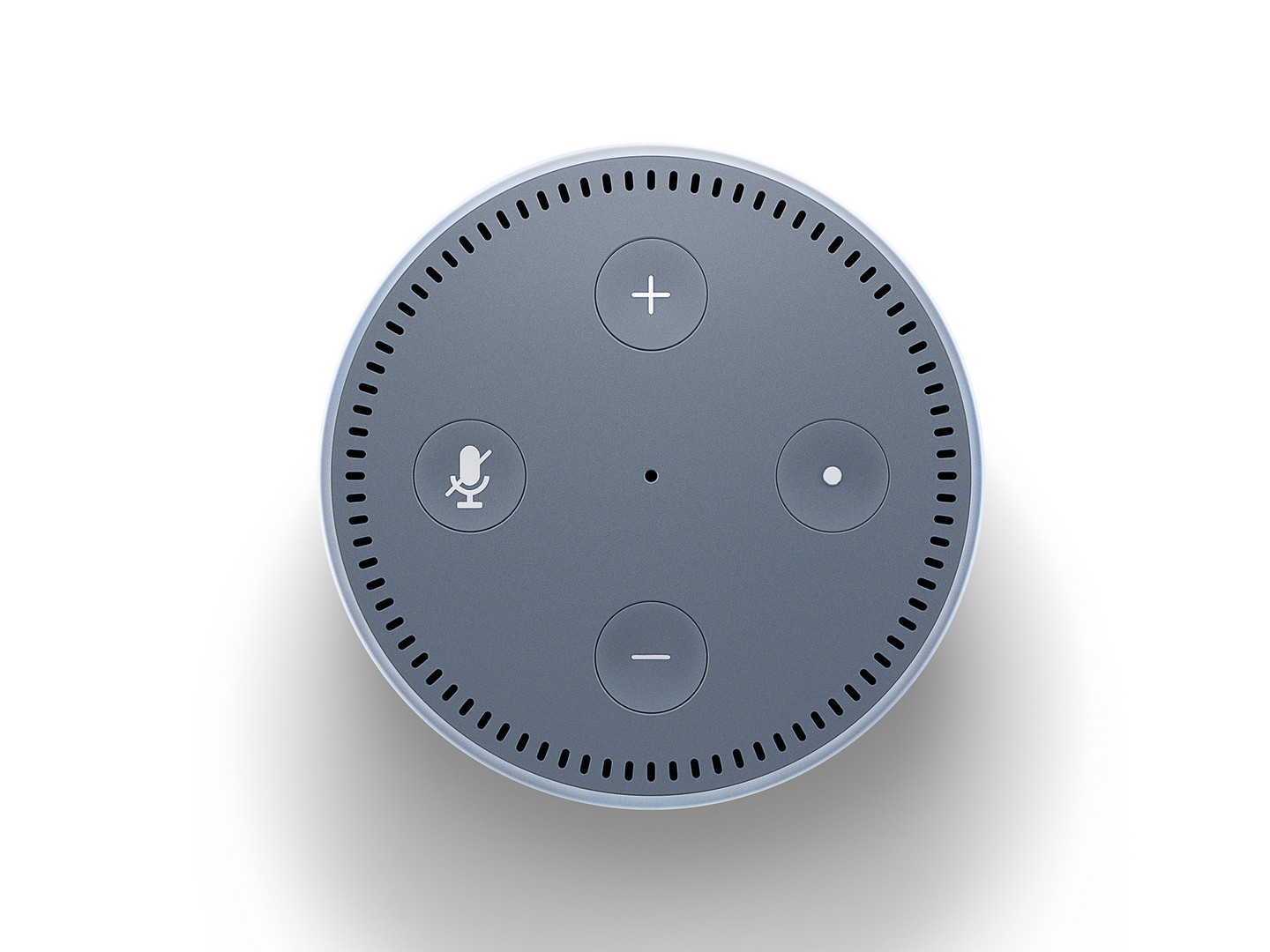
The buttons on the casing's upper side can be used for muting the microphones and volume control. There is also a so-called action button that is occasionally needed for setting up Amazon's Echo Dot.
Smart Home Control
One of the fundamental features of Amazon's Echo Dot is controlling Alexa Smart Home products via the assistant. The user can scan for compatible products within the home network directly with the Alexa app. Our experience showed that devices that use the ZigBee protocol are identified directly and can be controlled via Alexa immediately. Z-Wave products require Skills provided by the manufacturer. Alternatively, they can be added via the IFTTT (If This, Then That) service. However, this involves a higher configuration effort and less technically savvy users will find it more difficult to do.
We tested the functionality with Philips Hue lamps (ZigBee) and a Devolo Smart Home (Z-Wave). The Hue lamps were identified without issues and could be controlled directly. Alexa uses the lamps' names; unfortunately, the room settings of the Hue hub are disregarded. It is possible to turn the lights on and off and to dim them via voice control without further settings. Users who want to directly control different scenarios and moods will have to install an additional Skill. This adds corresponding commands for all lamps that are visible as Smart Home devices in the Alexa app. However, this can quickly become confusing and may require sorting.
Devolo products could only be controlled via IFTTT at the market launch, which is still possible. This functions quite well, but the service sometimes needs quite a long time (up to 30 seconds) before implementation. A Skill is now available for Devolo's Smart Home products, which allows implementing scenarios directly and which is also much faster.
Voice control itself functions well, but learning some vocabulary to prevent frustration is necessary at first. We would wish that Alexa had a bigger selection of supported synonyms. While "Alexa, switch on the lights" worked perfectly, everything remained dark when saying "Alexa, turn on the light".
Emissions and Energy Management
Speaker
The speaker quality is the biggest difference between Amazon's big Echo and the Echo Dot. While the more expensive model is quite suitable for listening to music, the smaller model only provides a limited quality and is made for voice output in our opinion.
The quality is acceptable, but a really good sound output is not possible. The sound impression is too unbalanced and the Echo Dot simply lacks power and volume especially at full volume. The mids and high tones are relatively linear, but the Echo is not capable of playing low tones and the speaker has problems with trebles starting at 6 kHz. Thus, the Dot tends to sound tinny at a high volume.
The output via the audio jack is decent. We would have wished for aptX protocol support for the Bluetooth connection.
Comments
Post a Comment